/b/as in bed
You likely produce English /b/ as an unaspirated voiceless stop — basically the same sound as the 'b' in pinyin, which is really a soft, breathless 'p' rather than a sound made with your voice turned on.

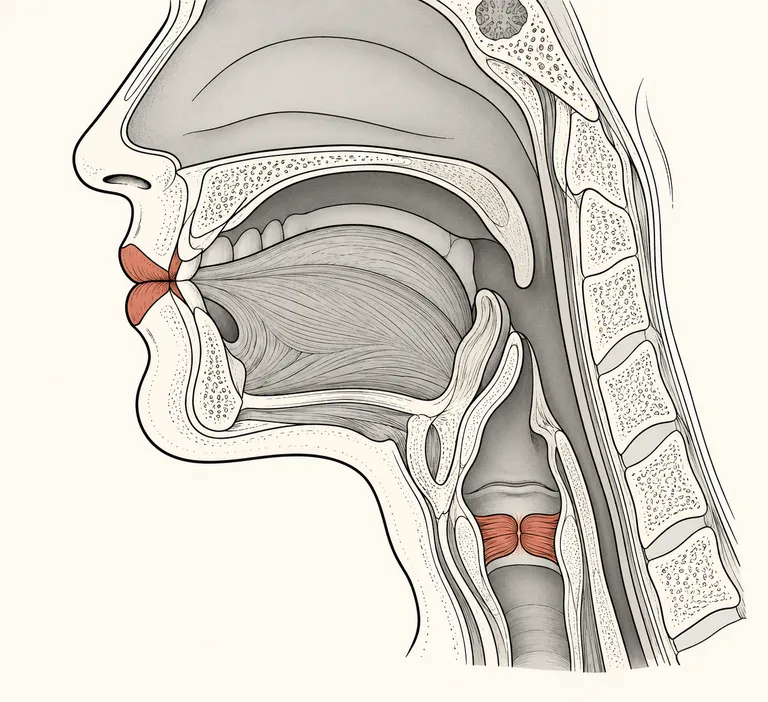
What you probably do
You likely produce English /b/ as an unaspirated voiceless stop — basically the same sound as the 'b' in pinyin, which is really a soft, breathless 'p' rather than a sound made with your voice turned on. This happens because Mandarin's stop consonants are organized entirely around aspiration, not around whether the vocal folds vibrate.
How natives do it
American speakers start vibrating their vocal folds before or during the lip closure, so you can hear a faint hum or buzz right through the silence of the stop, and the release afterward carries no extra puff of air. The lip movement is identical to 'p' — only the voicing is different.
Why it matters
Without real voicing, your /b/ can sound identical to an unaspirated /p/, risking confusion in words like 'bet' versus 'pet' or 'big' versus 'pig'. Adding genuine vocal fold vibration during the closure is a small habit that sharply increases how reliably native listeners tell your b's and p's apart.
Hear the difference
Words this touches
Mandarin Chinese speakers often substitute /p/.
How the mouth differs
Mandarin has no truly voiced stops at all; its 'b' (pinyin) is actually a voiceless, unaspirated [p], distinguished from aspirated pʰ only by the presence or absence of a puff of air. English /b/, by contrast, requires genuine vocal fold vibration during the lip closure itself. Learners transfer their unaspirated-vs-aspirated system, producing an unaspirated voiceless [p] wherever English wants a voiced [b].
Listen for the pattern
Because English listeners use aspiration, not voicing, as their main cue for word-initial stops in casual fast speech, a Mandarin speaker's unaspirated [p] substitute for /b/ is often heard correctly by context, but in careful or minimal-pair contexts (like 'bet' vs 'pet') it can cause real confusion, since true voicing is the only reliable cue there.
Reader ratings and feedback are coming soon.
Sources (2)
- Exploring Phonetic Differences and Cross-Linguistic Influences: A Comparative Study of English and Mandarin Chinese Pronunciation Patterns — 2024
- Mandarin speakers frequently substitute non-existent English sounds like /θ/ and /ð/ with /s/ or /z/, and struggle with voiced consonants due to lack of corresponding phonemes in their native system.
- English speakers often confuse Mandarin tones (particularly 2nd and 3rd) and mispronounce back vowels because English lacks a tonal structure and specific vowel inventory.
- Approximately 70% of surveyed learners identified phoneme differences as the main barrier to effective pronunciation in their target language.
- Duanmu, S. (2007). The Phonology of Standard Chinese. Oxford University Press.