Vowel reduction
You probably pronounce every vowel in an English word with its full, clear quality, the same way you would in Hungarian, because your first language never reduces unstressed vowels at all.

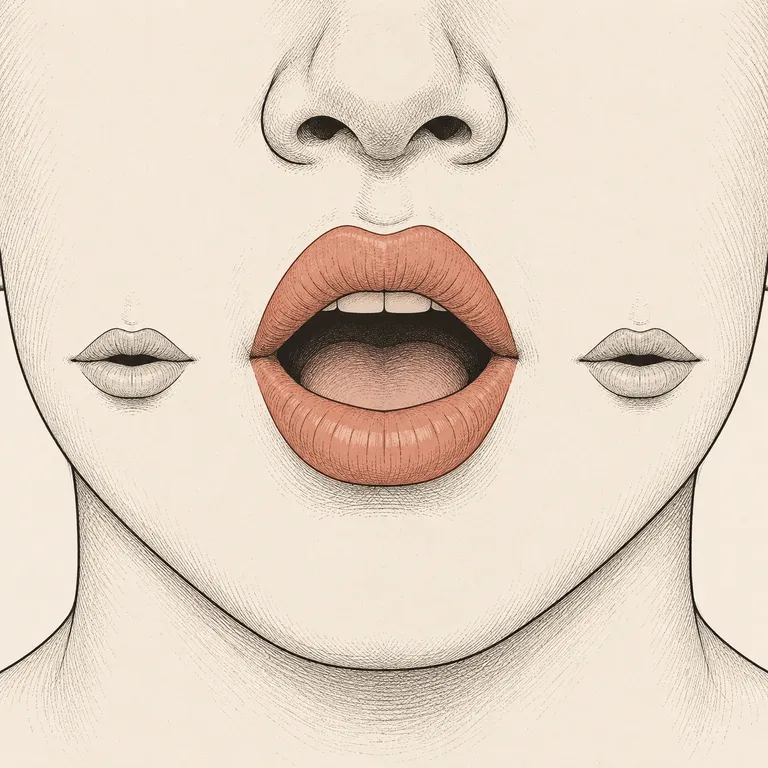
What you probably do
You probably pronounce every vowel in an English word with its full, clear quality, the same way you would in Hungarian, because your first language never reduces unstressed vowels at all.
How natives do it
Americans dramatically weaken unstressed vowels, letting most of them collapse into a quick, neutral 'uh' (schwa) sound, while reserving full, clear vowel quality only for the one stressed syllable in each word or phrase.
Why it matters
Vowel reduction is one of the biggest keys to sounding natural in English rhythm; without it, speech sounds overly careful and foreign, and — because reduction also helps signal which syllable is stressed — skipping it can make words genuinely harder to recognize quickly.
How the mouth differs
Hungarian unstressed vowels keep their full lexical quality — there is no schwa-like reduction at all. English systematically centralizes unstressed vowels toward schwa or a short lax vowel, sharply weakening them in loudness, length, and vowel quality compared to stressed syllables.
Listen for the pattern
Keeping every English vowel full and clear, as Hungarian habits encourage, makes speech sound overly precise, slow, and 'spelled-out' to American ears, which expect unstressed vowels to blur into a quick, low-effort 'uh'.
Try these sentences
- The photograph shows a photographer.Unstressed syllables ('-to-', '-pher') collapse toward a neutral schwa while the stressed syllable stays full and clear.
- Can you give me the banana?In 'ba-NA-na', the first and last vowels reduce to a quick schwa-like sound while only the stressed middle syllable keeps its full quality.
Practise it
Overdo the weak vowels, then dial it back
sourced- Say 'banana' with the first and last vowels almost silent — nearly whispering them: 'b'-NA-n'.
- Repeat this exaggerated version five times, keeping the middle 'NA' loud and full.
- Record yourself and confirm the outer vowels sound almost swallowed.
- Now say 'banana' again with a slightly less extreme reduction — a light, quick 'uh' instead of near-silence.
- Compare recordings: the natural version should still sound clearly weaker than the stressed syllable, just not whispered.
- Repeat with 'photograph' and 'photographer', exaggerated then natural each time.
- Finish by saying all three words at normal conversational speed, keeping the natural level of reduction.
Success check: Your natural version should still sound noticeably weaker on unstressed vowels than your exaggerated version's stressed syllable — just not as extreme as a whisper.

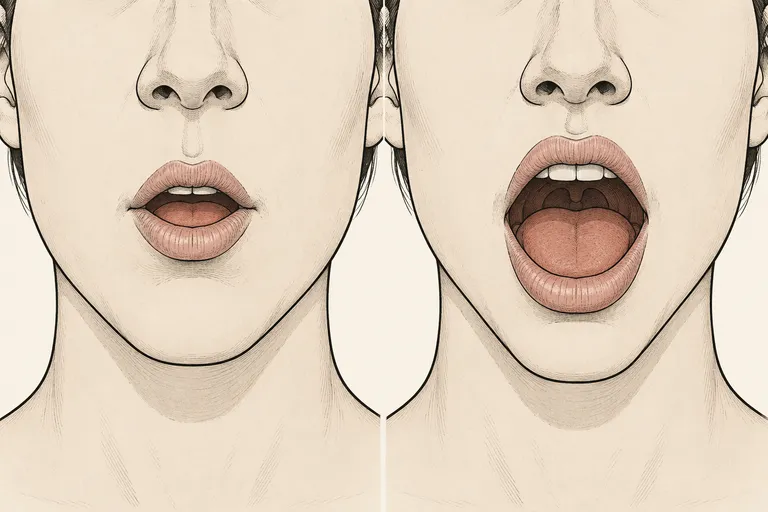
Why this works. Deliberately over-reducing unstressed vowels (whispering them almost to nothing) exaggerates the durational and quality contrast between stressed and unstressed syllables, similar to the acoustic overshoot shown to speed native-like categorical learning in phonetic training; the exaggerated weakening is then dialed back to a natural, less extreme level of reduction.
Sources (1)
- The Role of Temporal Acoustic Exaggeration in High Variability Phonetic Training: A Behavioral and ERP Study — Bing Cheng, Xiaojuan Zhang, Siying Fan et al., 2019
- The HVPT-E group showed greater improvement in natural word identification performance compared to the standard HVPT group.
- Training with temporal acoustic exaggeration induced native-like categorical perception based on spectral cues.
- MMN responses demonstrated training-induced changes at pre-attentive neural levels, suggesting enhanced brain plasticity.
Drill sentence: stressed vs. reduced vowels
sourced- Read this sentence slowly first: 'The photographer took a photograph of the banana.'
- Mark the one stressed syllable in each long word: pho-TOG-rapher, PHO-to-graph, ba-NA-na.
- Say the sentence very slowly, making only the marked syllables full and clear, and shrinking all the others toward a quick 'uh'.
- Record yourself saying it at normal conversational speed.
- Listen back: do the unmarked syllables sound weak and blurry, or are they just as clear as the stressed one?
- If they're too clear, repeat the sentence again, weakening the unstressed vowels more.
- Say the whole sentence five times at natural speed until the stress pattern feels automatic.
Success check: At normal speed, only the marked stressed syllables sound full and clear; every other vowel should sound quick and weak, like a fast 'uh'.
Why this works. Repeated drilling on a sentence with clearly marked stressed versus unstressed syllables trains the durable habit of collapsing unstressed vowels toward schwa under the demands of connected, natural-speed speech, where the fully-articulated L1 default is most likely to resurface.
Sources (1)
- Targeted Pronunciation Instruction in Multilingual Classrooms... — 2025
- Vowel contrast accuracy improved significantly from 62.5% to 78.3% in the targeted group, compared to only a 2.3% gain in the control group.
- Stress accuracy rose from 60.8% to 76.4% for learners receiving targeted instruction, with large effect sizes (d=1.48 for vowels, d=0.92 for stress).
- Qualitative data revealed that learners adopted durable strategies such as minimal pair drills and shadowing, leading to fewer real-world misunderstandings.
Shadow the rhythm of reduced vowels
sourced- Choose a short recording of a native speaker saying: 'Can you give me the banana from the photograph?'
- Listen to it three times, noticing which vowels sound short and blurry ('uh') versus full and clear.
- Play the recording again and speak along with it almost simultaneously, matching its rhythm exactly.
- Don't worry about perfect words at first — focus on copying the long-short-long pattern of syllables.
- Record your own shadowed version.
- Compare your recording to the original: do your unstressed vowels sound as short and blurry as the model's?
- Repeat the shadowing three more times, exaggerating the weakening of unstressed vowels a bit more each time.
Success check: Your shadowed recording should have the same short, blurry unstressed syllables and the same overall rhythm as the native model, not evenly weighted vowels throughout.
Why this works. Shadowing (speaking in near-simultaneous overlap with a native recording) forces the learner to match the rhythmic timing and vowel weakening of fluent speech in real time, bypassing the tendency to plan and articulate each vowel fully. Because Hungarian has no lexical reduction, explicit rule-based instruction is not enough; shadowing supplies the missing implicit rhythmic template through direct imitation.
Sources (1)
- Effects of prosody awareness training on the intelligibility of Iranian interpreter trainees in English — Mahmood Yenkimaleki, Vincent J. van Heuven, 2019
- Prosody awareness training led to a significant improvement in the speech intelligibility of Iranian interpreter trainees.
- The experimental group, which received explicit instruction on English prosodic features, outperformed the control group that only consumed authentic media.
- Intelligibility ratings increased after the intervention period for participants receiving prosody-focused training.
Reader ratings and feedback are coming soon.
Sources (1)
- Kenesei, I., Vago, R.M., & Fenyvesi, A. (1998). Hungarian: Descriptive Grammar.