



Resting mouth
You likely keep your tongue resting forward and fairly high, with your lips more actively rounded and engaged, and little to no habitual curling of the tongue tip — all carried over naturally from how Hungarian shapes…
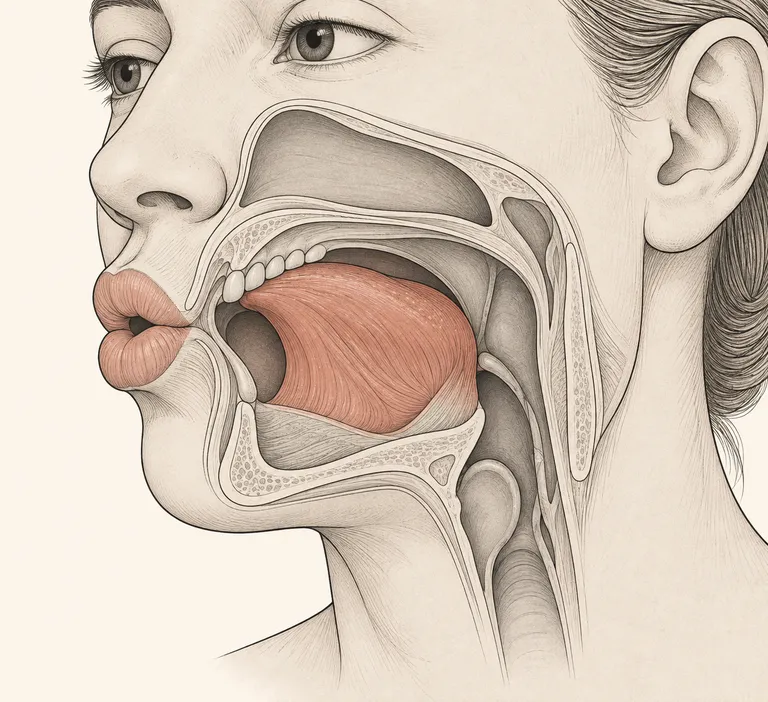

What you probably do
You likely keep your tongue resting forward and fairly high, with your lips more actively rounded and engaged, and little to no habitual curling of the tongue tip — all carried over naturally from how Hungarian shapes its mouth at rest.
How natives do it
General American speakers let the jaw and lips relax into a looser, more neutral position, rest the tongue body a little lower and further back, and keep the tongue tip subtly curled upward and back, ready at any moment to produce the ever-present American r.
Why it matters
This overall mouth 'setting' shapes every sound you make, not just individual phonemes; shifting your resting posture toward the looser, lower, r-ready American setting makes the whole accent — vowels, consonants, and r-coloring together — sound more natural with less individual sound-by-sound correction.
How the mouth differs
Hungarian holds the tongue body forward and fairly high at rest, reflecting its front-vowel-rich inventory, with active, engaged lips for its front-rounded vowels (ö, ő, ü, ű) and no habitual tongue-tip retraction. General American rests the tongue lower and slightly retracted, with the tip poised to curl back for the pervasive rhotic 'r', and keeps the lips mostly neutral with low overall muscular effort.
Listen for the pattern
Carrying Hungarian's forward, high tongue posture and active lip engagement into English can make American 'r' sounds weaker or tapped instead of retroflexed, and can add unintended lip rounding or fronting to vowels that should stay neutral and low-effort.
Reader ratings and feedback are coming soon.
Sources (2)
- Kenesei, I., Vago, R.M., & Fenyvesi, A. (1998). Hungarian: Descriptive Grammar.
- Wells, J.C. (1982). Accents of English.