This is an AI-generated research project, still being refined. It may contain errors. Reader ratings and feedback are coming soon. How this is made
For Polish speakers
Your English has a Polish shape. Here is
where.
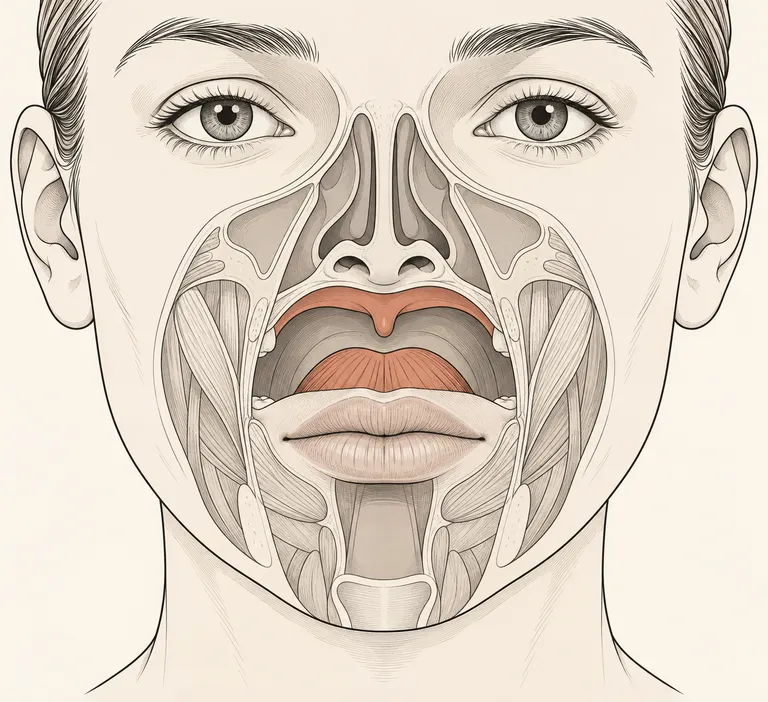
Polish speech uses a moderately firm jaw with lips held fairly neutral, rounding only occasionally for back vowels. At rest, the tongue sits high and forward, staying ready for Polish's many 'soft' consonants and its dense consonant clusters.
The Polish comparison is being researched. Daily tips are available.
Neutral restBaseline face at rest with lips neutral, jaw slightly closed, illustrating Polish's everyday resting posture.
Consonant cluster articulationTongue blade and tip tensed and precisely placed for a cluster onset such as in 'wstrz-'.
Nasal vowel articulationVelum lowered slightly to produce the nasal vowel 'ą', with soft nasal resonance visible in the diagram.
Polish's dense consonant clusters and nasal vowels call for precise tongue-blade control and selective velum lowering, contrasting with English's simpler syllable onsets.
How Polish moves
sourced
Polish is syllable-timed, so syllables tend to land at a fairly even pace rather than English's uneven, stretch-and-squeeze rhythm. Stress almost always falls on the second-to-last syllable of a word, and it's a gentle push rather than a strong beat. Vowels keep their full quality in nearly every position, so you won't hear the reduced, mumbled 'uh' vowels that are so common in English unstressed syllables.
Where Polish rests
sourced
Polish speech uses a moderately firm jaw with lips held fairly neutral, rounding only occasionally for back vowels. At rest, the tongue sits high and forward, staying ready for Polish's many 'soft' consonants and its dense consonant clusters. The cheeks stay fairly still, and the throat carries a touch more tension than in English, which helps produce crisp, clearly separated consonant sounds. The soft palate opens for a couple of special nasal vowels, giving some words a light nasal color. Overall muscle tension is moderate to firm, especially in the tip and blade of the tongue, which have to move precisely and quickly through consonant strings. The voice itself sounds clear and steady, with crisp releases on consonants.
Standard Polish (Warsaw-based educated norm); regional varieties differ mainly in vowel quality and intonation but share the consonant and stress system described here