/θ/as in think
Since neutral Latin American Spanish has no sound like this at all, you probably replace English θ with your regular 's' sound, keeping your tongue tip behind your teeth and shaping a narrow groove for a sharp hiss, or…
What you probably do
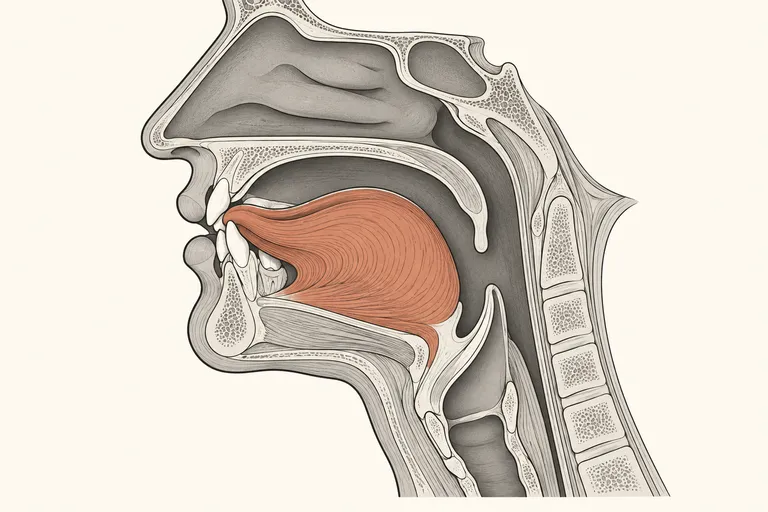
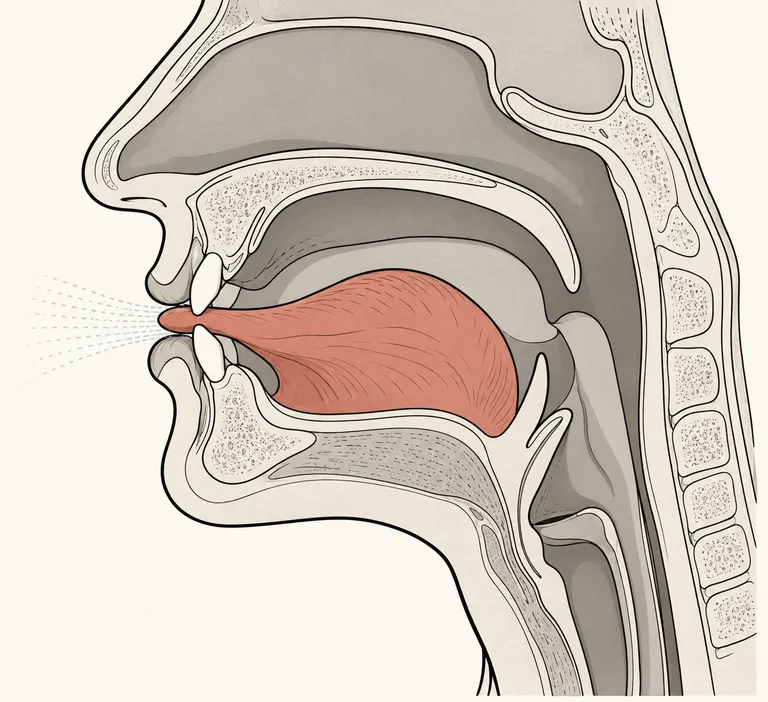
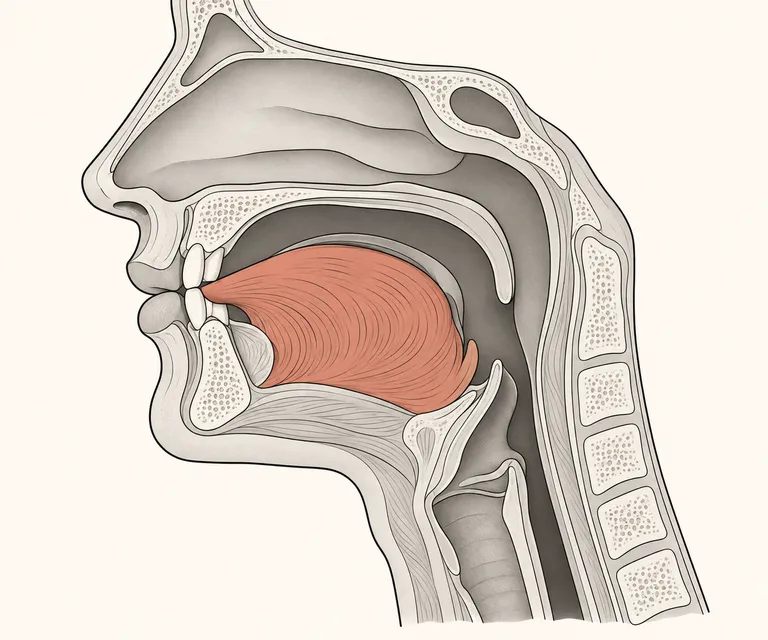
Since neutral Latin American Spanish has no sound like this at all, you probably replace English θ with your regular 's' sound, keeping your tongue tip behind your teeth and shaping a narrow groove for a sharp hiss, or sometimes substitute a 't' instead, since both feel like the closest available Spanish sounds.
How natives do it
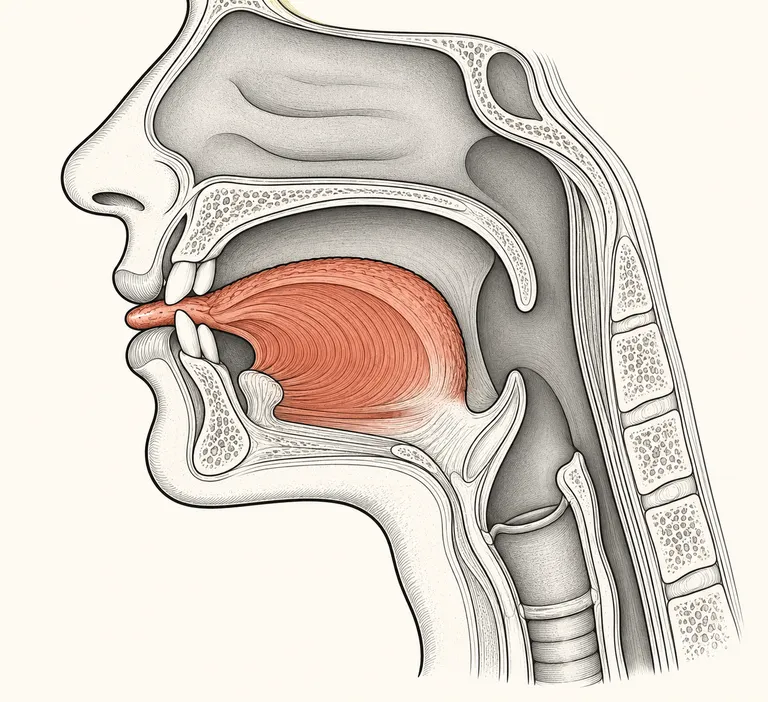
Americans let the tip of the tongue protrude gently between the upper and lower front teeth and blow air steadily over its flat surface, producing a softer, more diffuse hiss than 's' with no groove shaping and no vocal fold vibration.
Why it matters
Because this substitution collapses distinct English words into the same sound — 'think' becomes indistinguishable from 'sink', and 'thin' from 'sin' — this is one of the few sound confusions for Spanish speakers of English that can cause genuine misunderstanding rather than just sounding accented.
Hear the difference
Words this touches
Spanish speakers often substitute /s, t/.
How the mouth differs
Neutral Latin American Spanish has no interdental fricative at all (Castilian Spanish uses θ only for c/z before e, i, in a different distribution); English θ requires the tongue tip to protrude lightly between the teeth, letting air hiss over it, a gesture most Spanish speakers have never practiced and typically replace with the nearest alveolar fricative s, or occasionally with t.
Listen for the pattern
Substituting s for θ turns 'think' into 'sink' and 'thin' into 'sin' for American listeners, creating genuine word confusion rather than just an accent marker, since English maintains these as fully distinct, unrelated words.
Practise it
Tell Think from Sink
sourced- Listen to pairs of words: think/sink, thank/tank, bath/bat, mouth/mouse.
- For each pair, decide which word you heard, 'A' or 'B'.
- Focus on the key sound: is there a soft, breathy hiss (θ) or a sharper 's' hiss or a hard 't' tap?
- Check your answers against the answer key.
- Replay any pair you got wrong three times, paying attention only to that one consonant.
- Redo the whole set until you score at least 9 out of 10 correct.
Success check: You can consistently tell θ words apart from their t/s-substituted twins without seeing the spelling, even in random order.
Why this works. Presenting minimal pairs like think/sink and thank/tank in randomized order trains the learner's phonemic decision boundary between the dental fricative θ and the alveolar sounds t/s that Hungarian substitutes for it; sharpening perceptual discrimination first improves the accuracy of self-monitoring during later production practice.
Sources (1)
- Distinguishing universal and language-dependent levels of speech perception: Evidence from Japanese listeners' perception of English “l” and “r” — Virginia A. Mann, 1986
- Japanese listeners successfully discriminate the acoustic properties of English /l/ and /r/ when presented with non-English contrasts, ruling out a universal hearing deficit.
- The primary source of error is language-dependent categorization, where listeners map English sounds onto their existing L1 phonological categories (e.g., classifying both as liquids).
- Performance improves significantly when the acoustic contrast between /l/ and /r/ is exaggerated or presented in contexts that highlight their distinctiveness.
Build θ One Step at a Time
consensus- Open your mouth slightly and relax your jaw.
- Slowly stick your tongue tip out just past your upper front teeth — pause here for a second.
- Let your upper teeth rest lightly on top of the tongue tip, no pressure.
- Blow a slow, steady stream of air over the tongue tip; listen for a soft hiss with no voicing.
- Hold that hiss for two full seconds.
- Slowly pull your tongue back behind your teeth as the airflow fades out.
- Now repeat all the steps slightly faster, until it feels like one smooth motion.
- Attach the sound to the start of 'think': hold the θ for a beat, then finish the word normally.
Success check: You can feel your tongue tip touch or nearly touch your teeth and hear a clean, voiceless hiss before you ever add a vowel.
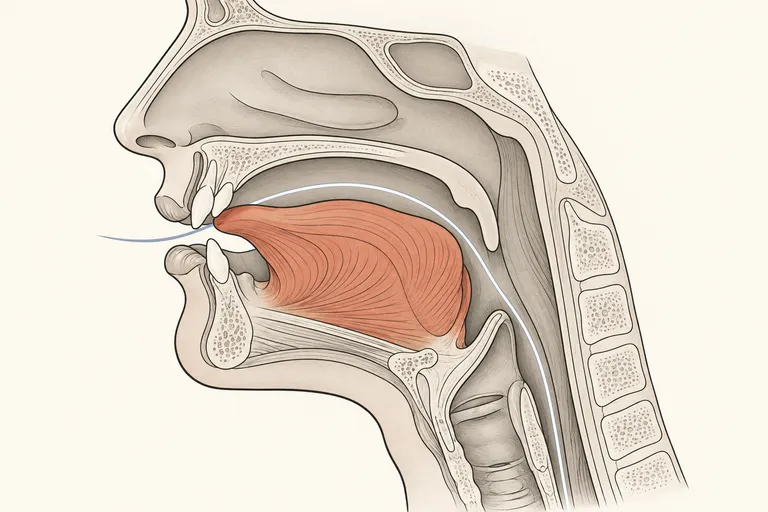
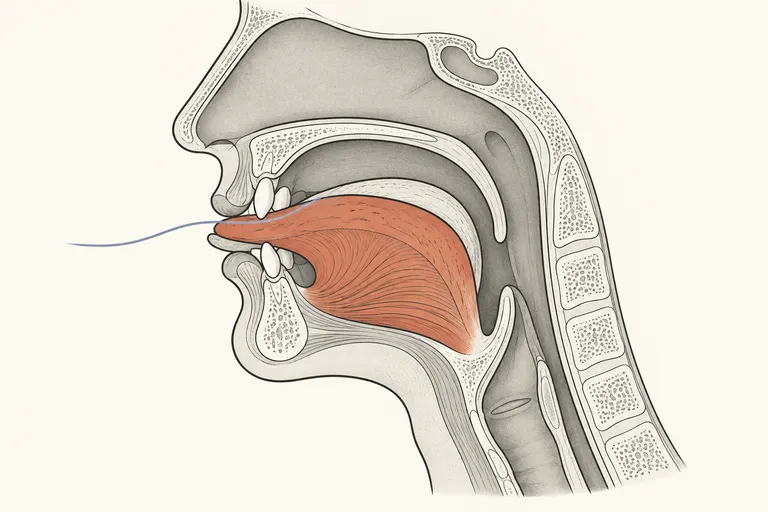
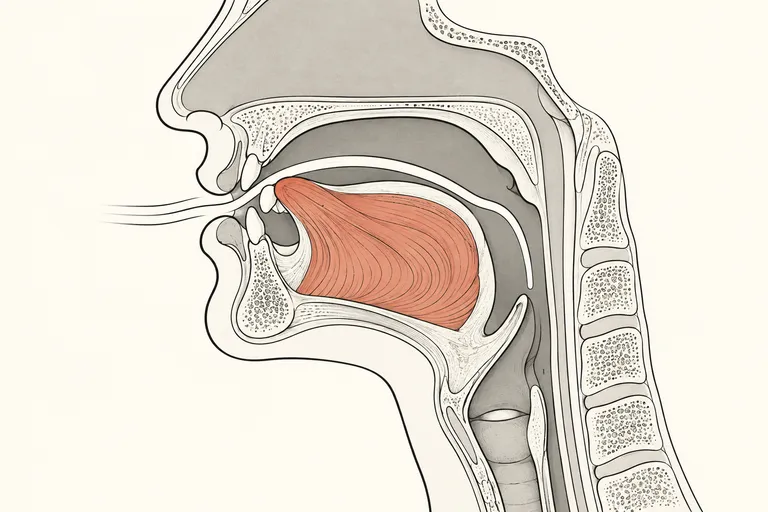
Why this works. Slowing the gesture into discrete steps — jaw drop, tongue protrusion, steady airflow, retraction — lets the learner consciously control each phase of an articulation with no counterpart in Hungarian, before reassembling it at normal speed into a single automatic motion.
Sources (1)
- Ladefoged, P. & Johnson, K. (2015). A Course in Phonetics.
Practice θ in a Full Sentence
sourced- Read this sentence slowly: 'I think the three thin brothers took a bath on Thursday.'
- Go word by word, exaggerating the tongue-tip-between-teeth gesture on every θ word.
- Record yourself reading it at a slow, careful pace.
- Play it back and mark any θ that sounded like 't' or 's'.
- Repeat the sentence three more times, speeding up slightly each time while keeping the tongue protrusion visible in the mirror.
- Read it once more at a natural conversational speed.
Success check: Every θ in the sentence should show a brief tongue-tip appearance in the mirror and produce a soft hiss, even at natural speed.
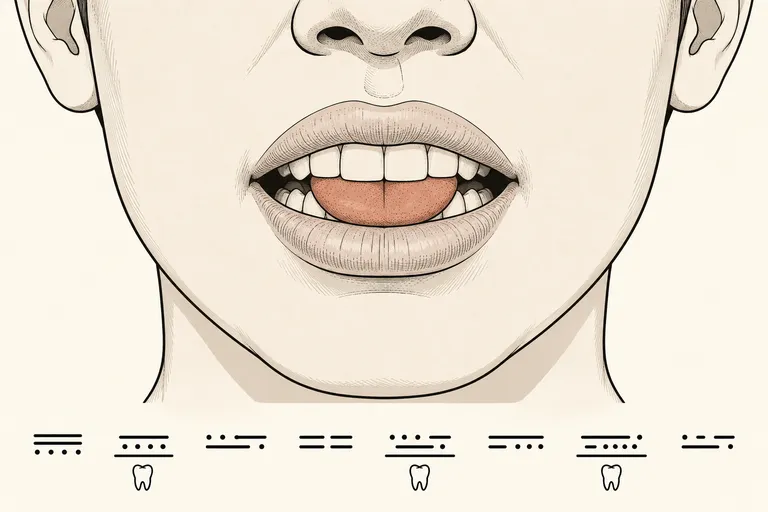
Why this works. Embedding θ in full sentences with multiple instances forces repeated, rapid re-execution of the tongue-protrusion gesture amid the coarticulatory pressure of neighboring sounds, which is the real test of whether the new gesture has become automatic rather than a careful, isolated performance.
Sources (1)
- Training the pronunciation of L2 vowels under different conditions: the use of non-lexical materials and masking noise. — Joan C Mora, Mireia Ortega, Ingrid Mora-Plaza et al., 2022
- Non-lexical training materials produced greater pronunciation improvements for L2 learners compared to lexical (word-based) materials.
- Masking noise during training hindered performance specifically for participants using non-lexical stimuli, but did not negatively affect those using words.
- Training-induced gains in vowel production were more pronounced when vowels appeared in sentences than when elicited in isolated words.
Stick It Out, Then Pull Back
sourced- Say 'think' with your tongue tip pushed way out past your teeth, further than feels natural.
- Exaggerate the hiss too, holding it for a full two seconds.
- Now say 'think' again with the tongue only slightly poking out, closer to normal speech.
- Compare: both versions should have a clear hiss, just with different amounts of visible tongue.
- Repeat this big-then-small pattern with 'three', 'bath', and 'mouth'.
- Finish with five natural-speed repetitions of all four words.
Success check: Your natural-speed θ should still show a small but clearly visible tongue-tip peek and a soft hiss — a scaled-down version of the exaggerated one, not a collapse back into 't' or 's'.
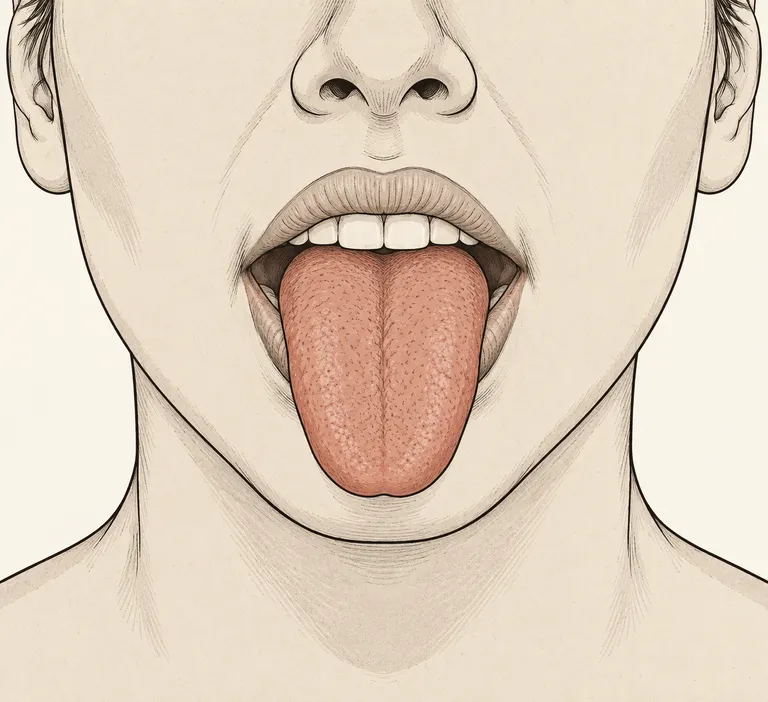

Why this works. Overshooting the tongue protrusion — pushing it further out than natural speech requires — exaggerates the acoustic and proprioceptive contrast between θ and the learner's habitual t/s substitutes; research on acoustic exaggeration in training shows this strengthens the new perceptual-motor category before the gesture is dialed back to a subtler, natural-speed protrusion.
Sources (1)
- The Role of Temporal Acoustic Exaggeration in High Variability Phonetic Training: A Behavioral and ERP Study — Bing Cheng, Xiaojuan Zhang, Siying Fan et al., 2019
- The HVPT-E group showed greater improvement in natural word identification performance compared to the standard HVPT group.
- Training with temporal acoustic exaggeration induced native-like categorical perception based on spectral cues.
- MMN responses demonstrated training-induced changes at pre-attentive neural levels, suggesting enhanced brain plasticity.
Say the Pairs, Feel the Difference
sourced- Look in the mirror and say 'think', watching your tongue tip poke out between your teeth.
- Now say 'sink' right after, pulling your tongue back behind your teeth for the 's'.
- Alternate: think-sink, think-sink, five times, exaggerating the tongue position change each time.
- Repeat with thank-tank, bath-bat, and mouth-mouse.
- Record yourself producing all four pairs.
- Play it back and check that the θ words show visible tongue protrusion in the mirror and a soft hiss on playback, while the t/s words don't.
Success check: Your tongue tip should briefly appear between your teeth only on the θ words, with a soft, breathy hiss rather than a sharp 's' or hard tap.
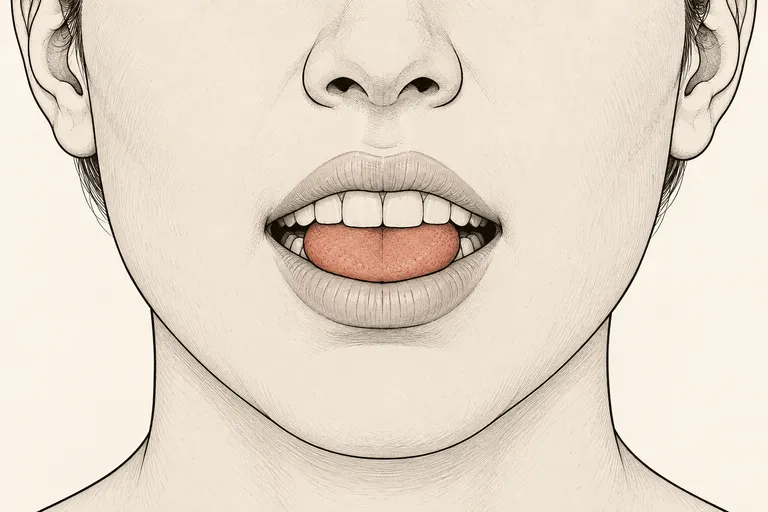
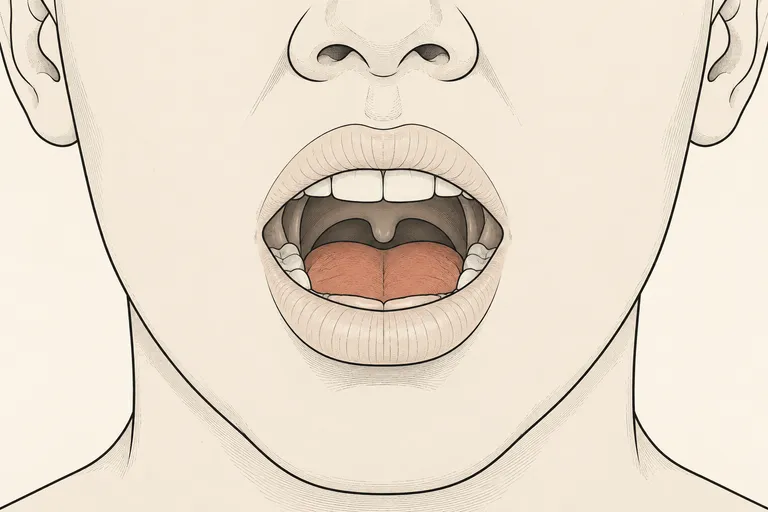
Why this works. Producing minimal pairs back-to-back forces a rapid articulatory switch between the protruded-tongue fricative θ and the retracted stop or fricative (t/s) already automatized in Hungarian, strengthening the motor contrast needed to keep the two categories separate in running speech.
Sources (1)
- Distinguishing universal and language-dependent levels of speech perception: Evidence from Japanese listeners' perception of English “l” and “r” — Virginia A. Mann, 1986
- Japanese listeners successfully discriminate the acoustic properties of English /l/ and /r/ when presented with non-English contrasts, ruling out a universal hearing deficit.
- The primary source of error is language-dependent categorization, where listeners map English sounds onto their existing L1 phonological categories (e.g., classifying both as liquids).
- Performance improves significantly when the acoustic contrast between /l/ and /r/ is exaggerated or presented in contexts that highlight their distinctiveness.
Push Your 't' Forward Into θ
consensus- Say a crisp 't' and notice where your tongue tip touches — right behind your top front teeth.
- Say 't' again, but let the tongue tip slide a little further forward, to the back of your top teeth.
- Push just a bit further so the tongue tip peeks out between your teeth.
- Instead of stopping the air completely like 't' does, let a thin stream of air hiss continuously over the tongue tip.
- Practice the transition: 't... t... th... th...', feeling the tongue creep forward each time.
- Attach the final 'th' position to the word 'think', starting each rep from the 't' spot and sliding forward.
Success check: You should feel the tongue-tip motion as a small forward slide from your familiar 't' spot, ending with the tip lightly between your teeth and a steady hiss instead of a stopped sound.
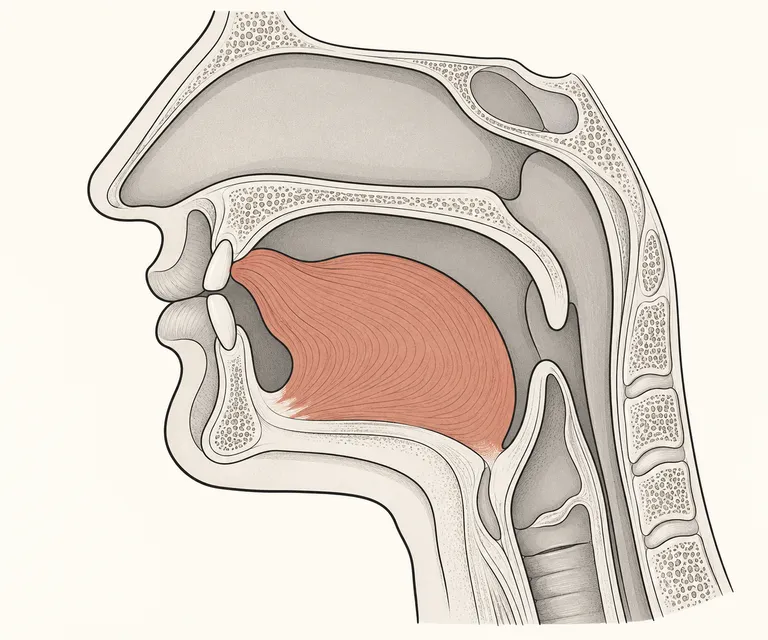
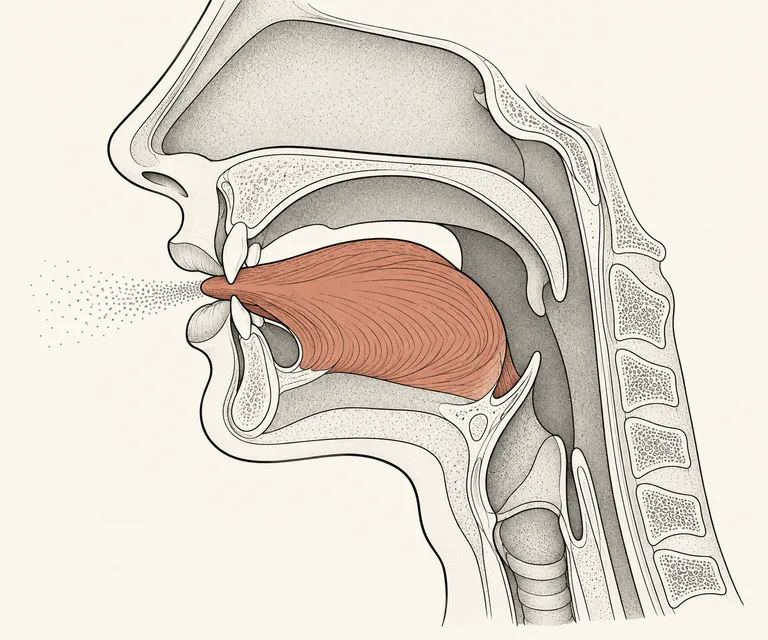
Why this works. θ recruits the same tongue-tip fronting muscles (genioglossus anterior and tongue-tip flexors) already used for the native alveolar stop 't'; by taking the familiar 't' tongue-tip gesture and sliding it a few millimeters further forward past the alveolar ridge to the teeth, learners repurpose an existing motor program instead of building an entirely new one.
Sources (1)
- Celce-Murcia, M., Brinton, D., & Goodwin, J. (2010). Teaching Pronunciation.
Reader ratings and feedback are coming soon.
Sources (1)
- Wells, J.C. (1982). Accents of English.