Linking
You likely keep words more separated, using Spanish-style linking mainly by moving a final consonant onto the next word's vowel, but rarely inserting a glide sound between two vowels that meet at a word boundary.

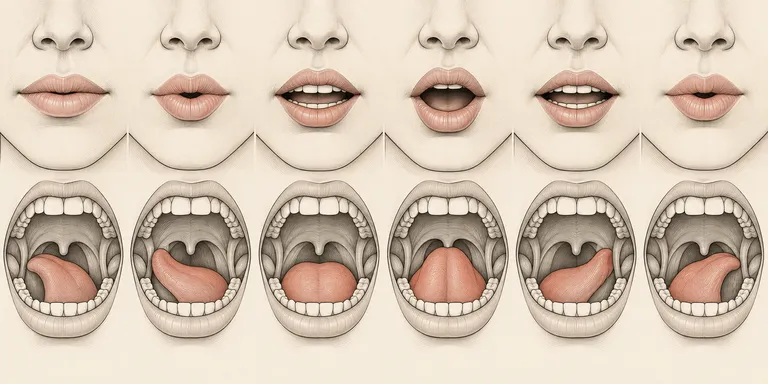
What you probably do
You likely keep words more separated, using Spanish-style linking mainly by moving a final consonant onto the next word's vowel, but rarely inserting a glide sound between two vowels that meet at a word boundary.
How natives do it
Americans glide final consonants smoothly into the next word's vowel constantly, and they also insert small w, j, or r sounds between adjacent vowels across word boundaries, turning strings of separate words into continuous, connected chains of sound.
Why it matters
Fast, connected English relies heavily on this linking to sound natural and to be easy to follow; speaking with words too separated can sound choppy or overly formal, and can make it harder to catch fluent native speech that leans on these same links.
How the mouth differs
Spanish links words mainly by resyllabifying a final consonant onto a following vowel-initial word (as in 'los amigos'), but rarely inserts glides between two vowels or carries a final r across a word boundary; English does both constantly, gliding consonants into following vowels and inserting w, j, or r sounds between adjacent vowels across word boundaries.
Listen for the pattern
Speaking English with distinct, separated words rather than continuous liaison chains makes speech sound choppy and overly careful to native ears, and can also make it harder for listeners to parse fast, casual speech where linking is expected.
Try these sentences
- Turn it off before you go.'turn it' and 'it off' link into smooth chains (turn-i-toff), with the final consonants of 'turn' and 'it' gliding directly into the next vowel
- Far away, an idea came to her.the r in 'far' links across into 'away' (fa-raway), and an intrusive glide connects 'idea' to 'an'
Reader ratings and feedback are coming soon.
Sources (2)
- Wells, J.C. (1982). Accents of English.
- Hualde, J.I. (2005). The Sounds of Spanish. Cambridge University Press.